
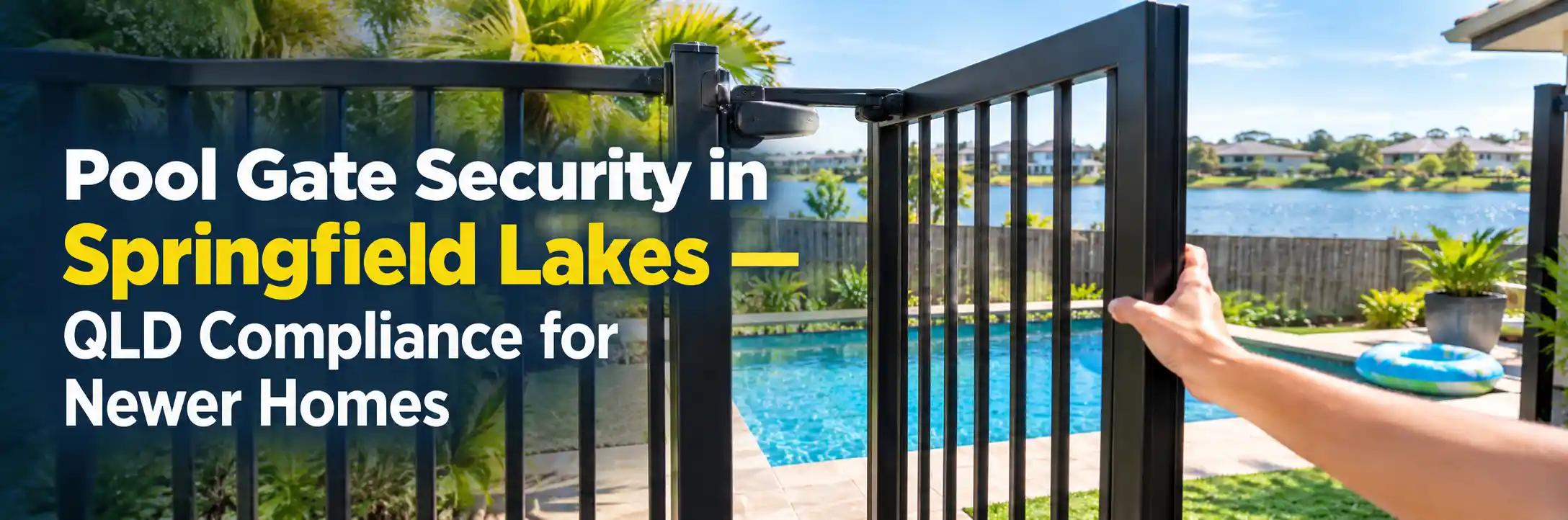
Pool gate security in Springfield Lakes is a conversation shaped by two specific factors: Queensland’s mandatory pool safety laws, which apply to every swimming pool in the state regardless of when it was built; and Springfield Lakes’s newer housing stock, where pools were installed in the 2000s and 2010s to the specifications of the time, which may differ from the current Queensland Pool Safety Standard. Pool gate security in Springfield Lakes for these properties involves understanding what the current law requires, how to test whether the existing hardware meets it, and what the specific considerations of newer Queensland construction create.
Queensland pool safety law — pool gate security Springfield Lakes baseline
Pool gate security in Springfield Lakes starts with Queensland’s mandatory framework under the Building Act 1975 (QLD) and the Queensland Pool Safety Standard. Every swimming pool in Queensland — including pools installed when the suburb was developed in the 2000s — must meet the current Pool Safety Standard. The key requirements:
- Pool gates must be self-closing and self-latching — closing and latching automatically from any open position without being manually pushed
- Pool gate latches must be positioned on the pool side of the gate, at a height that children on the non-pool side cannot reach, or within a child-resistant housing
- Pool gates must open outward from the pool or have a latch that is inaccessible to children from the non-pool side
- The pool fence must be a continuous barrier with no climbable features on the non-pool side within 900mm of the fence
- A pool safety certificate issued by a licensed pool safety inspector is required before a Queensland property with a pool can be sold or leased
Newer homes and pool gate security Springfield Lakes — the compliance gap
Pool gate security in Springfield Lakes for homes built in the 2000s and 2010s has a specific compliance gap that is not obvious from the outside. The Queensland Pool Safety Standard has been updated since many Springfield Lakes pools were installed. A pool gate and fence that were compliant when the home was built in 2008 may have specific elements that no longer meet the 2010 Pool Safety Standard update or subsequent amendments.
The most common compliance gaps in Springfield Lakes’s newer pool stock:
Self-closing mechanism degradation. Pool gate closers — spring-loaded hinges or hydraulic closers — have a finite service life in Queensland’s outdoor UV and humidity environment. A closer that was functioning correctly when installed in 2008 may have lost sufficient tension to reliably close a gate that has also sagged slightly on its hinges after fifteen years. The combination of a degraded closer and a slightly sagged gate produces a gate that closes slowly and may not latch on every closure.
Latch height and child resistance. If furniture, garden features, or landscaping has been added within 900mm of the non-pool side of the pool fence since the pool was installed, the fence may no longer comply with the climbable features restriction. A garden bed that provides a step-up surface adjacent to the fence was not there when compliance was originally assessed.
The self-closing test — pool gate security Springfield Lakes
Pool gate security in Springfield Lakes self-closing assessment follows the same method for newer homes as for older ones. The test that matters: open the gate to its widest possible position, release it without assistance, and observe whether it closes and latches completely without any push. Then repeat from a half-open position. Then from approximately 30 degrees open.
A compliant Springfield Lakes pool gate must self-close and self-latch from every open position.
A gate that closes from the widest position but stalls at half-open, or that closes but does not latch without a final push, is not compliant. The specific failure determines the repair: a stalling gate typically needs a closer adjustment or replacement; a gate that closes but does not latch needs latch mechanism assessment or realignment of the gate within the frame.
The self-closing test is the assessment that every Springfield Lakes pool owner should do independently at least twice a year — before the summer swimming season and again at mid-year. Pool gate hardware in Queensland’s outdoor environment degrades faster than the same hardware in an indoor setting, and a gate that was compliant at the last pool safety inspection may not be compliant twelve months later.
The pool gate as a residential security element
Pool gate security in Springfield Lakes also addresses the pool gate’s function as a residential entry point, not just a compliance element. In many Springfield Lakes family homes, the pool area is accessible from the rear yard, and the pool fence and gate are the barrier between the rear garden and the pool surrounds. A pool gate with a compliant latch on the pool side and a key-operated lock on the outside provides both the QLD compliance requirement and controlled access to the pool area from outside the property.
For Springfield Lakes properties where the pool gate is also the primary access point from the rear yard to the pool area — particularly for properties whose rear yard is adjacent to the lake trail — the pool gate hardware serves the dual function of compliance barrier and rear boundary security element. A keyed pool gate lock that meets the Queensland Pool Safety Standard’s child-resistance requirements closes both the compliance gap and the rear access gap simultaneously.
Pool safety certificates and Springfield Lakes property transactions
Pool gate security in Springfield Lakes has a specific relevance for property sales and leases. A pool safety certificate issued by a licensed pool safety inspector is required before a Springfield Lakes property with a pool can be sold or leased. The certificate confirms compliance with the current Queensland Pool Safety Standard at the time of inspection.
For Springfield Lakes homeowners planning to sell or lease their property, having the pool gate and fence assessed informally before engaging a pool safety inspector allows any compliance gaps to be addressed before the formal inspection.
Gaps identified and remediated before the inspector visits produce a straightforward certificate. Gaps identified during the formal inspection require remediation before the certificate is issued, adding time and logistical complexity to a transaction that already has its own schedule pressures.
Ipswich City Council pool registration
Pool gate security in Springfield Lakes includes a registration requirement that some homeowners are unaware of. In Queensland, all swimming pools must be registered on the Queensland Government’s Pool Safety Register. Ipswich City Council is the local government authority for Springfield Lakes and may have additional local requirements. Pool owners can confirm registration status through the Queensland Government’s pool safety register online.
Pool gate security in Springfield Lakes in the Peninsula neighbourhood — the final stage of Springfield Lakes development, built immediately behind Regatta Lake and Discovery Lake — has the specific combination of lakeside rear boundary and pool ownership that creates a dual security and compliance consideration. A Peninsula property with both a rear boundary adjacent to a lake trail and a pool in the backyard has two access control requirements: the keyed rear gate for the lake trail boundary, and the compliant pool gate for the Queensland Pool Safety Standard. Where the pool fence runs along the rear boundary adjacent to the lake trail, the pool gate may serve both functions simultaneously.
The compliance requirements of the Pool Safety Standard take precedence and must be met first — with the keyed latch option satisfying both the child-resistance compliance requirement and the trail-side access control requirement in a single hardware specification.
The Peninsula neighbourhood and lakeside pool considerations
The pool gate that is opened and closed twenty times on a busy summer Saturday by children moving between the pool and the house is the pool gate that will reveal any self-closing or self-latching deficiency most quickly. A gate that works correctly ninety-nine times and fails to latch once creates the window that pool safety requirements are designed to prevent.
Pool gate security in Springfield Lakes at the frequency that active family use creates means the hardware needs to be in genuinely reliable condition — not approximately compliant, but consistently compliant under actual use conditions.
Pool gate security in Springfield Lakes exists in the context of the suburb’s outdoor family lifestyle. Springfield Lakes’s warm Queensland climate, the family demographic with young children, and the spacious blocks of the 2000s estate development mean pools are common and heavily used throughout the year. The pool is not a seasonal amenity in Springfield Lakes — it is a daily family space during Queensland’s long warm season. This year-round use means the pool gate hardware is activated multiple times daily and the compliance requirement is not a once-a-year consideration but an everyday safety system.
The backyard pool and Springfield Lakes family lifestyle
Conclusion
Pool gate security in Springfield Lakes meets Queensland’s mandatory requirements and protects the young families that make up the suburb’s community. The twice-yearly self-closing test, the compliance assessment before any property transaction, and the keyed gate lock that satisfies both compliance and rear boundary security together address what pool gate security in Springfield Lakes requires for the suburb’s newer family homes.